Frequently Asked Questions
What kind of components can be produced?
Metal components for glasses and plastic embellishments for glasses, parts for micromechanics and electronics, parts for fuel cells, special runs of precious objects, logos, ornaments and decorations, parts for fountain pens and watches, complicated mechanisms for musical instruments, details for railway, naval or automotive modeling, modern art objects, carnival masks, clothing accessories, costume jewelry, nameplates, small sculptures, reproductions of rare coins and ancient weapons, handles and small parts for antiques and vintage cars, etc…

What is needed to create components?

A simple drawing on paper or in the following graphic formats: dwg, dxf (AutoCAD or other software that uses these formats), 3dm (Rhinoceros), stl, igs, cdr (Coreldraw), ai (Illustrator), pdf, fh11, tiff, bmp, tga, eps and others. Sometimes a photograph may be sufficient, if accompanied by the most important dimensions.
We can reproduce a master model in metal, built in practically any material: metal, plastic, wood, plaster, wax, even composed of multiple parts welded or glued together. The micro-cast reproductions will have a reduction (shrinkage) of about 1.5 - 2% compared to the original. It is good practice to indicate the most important dimensions to be respected and where to place the feed channel.
Technical and informational sheets are available in the materials section, and on our app:


How much does it cost to create my component in metal?
Calculating the price of your component is now very easy!
Go to the pricing page and choose the sizes and metal... here's how much it will cost you! No need to register or wait.
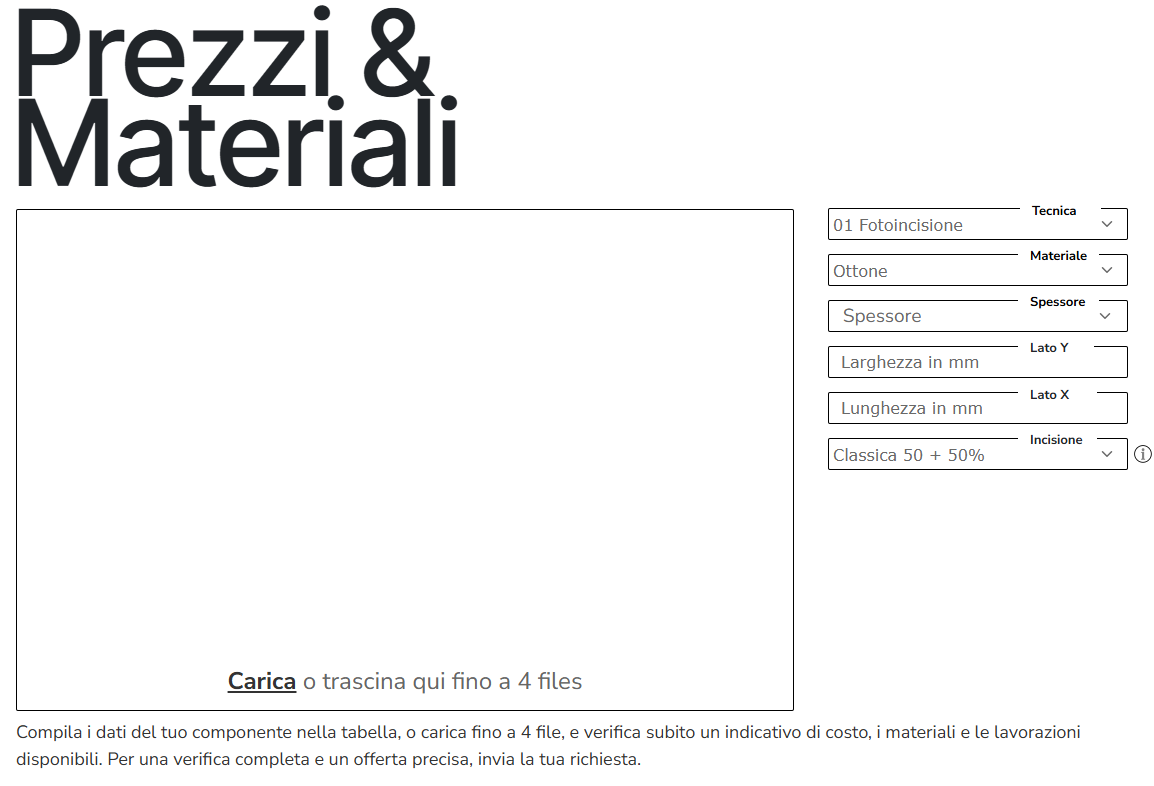
Se poi vuoi ricevere una offerta dettagliata inviaci i tuoi disegni, fotografie o modelli, e ti risponderemo in poche ore.
How is the price of microfusion calculated?

You can easily and immediately check the cost of each component in the pricing section.
You just need to calculate the volume of the parallelepiped that can contain the piece, that is, the maximum length, width, and height.
Do molds cost a lot?
Our processing methods do not require molds.
For photochemical etching and electroforming, the plates are masked using a high-definition digital process (xmos).
Microfusion also does not require traditional molds, but rather short-lived rubber and ceramic matrices.
At the beginning of the processing of each item, and only for the first time, a simple "setup fee" of a few dozen Euros is charged, depending on the size of the model and the complexity of the design.
What is the minimum quantity I can order?
In photochemical etching, only 2 plates (or all the pieces they can contain).
In microfusion, the minimum order is only 2 pieces per item.
With laser cutting, the minimum quantity depends on the design and must be calculated.
In electroforming, the minimum quantity is 10 adhesive sheets of 100x300 mm.
What is "chemical photochemical etching"?

Chemical photochemical etching or phototrimming is a modern system for cutting and precisely etching metal plates, even very thin ones, advantageously replacing traditional trimming and etching operations.
The design of the requested detail is processed on a computer and then "photographed" onto the metal sheet. A sophisticated acid bath process dissolves the outlines and perforates and engraves the plate on multiple levels.
What materials can be used in photochemical etching?

Brass, bronze and special bronzes, alpaca, beryllium copper, aluminum, common steels, special steels, and stainless steel. The sheets can have sizes ranging from 100 x 300 mm to 400 x 1000 mm, with thicknesses from 0.03 to 1.2 mm.
What kind of finish can I achieve for photochemically etched pieces?
The parts are normally delivered "in sheet form", with smooth surfaces, polished appearance, and two small easily removable witnesses (attachments).
Copper alloys (brass, bronze, and nickel silver) can be easily soldered with tin or welded with silver alloy, polished with special abrasive wheels, or with tumbling and vibrating systems.
EXELLA materials are tested to accept all common galvanic treatments (copper plating, nickel plating, silver plating, gold plating, rhodium plating, etc.). Beryllium copper is suitable for heat treatments of solutionizing and aging, to achieve remarkable elasticity and hardness characteristics (even over 400 Vickers). Stainless steels with a pre-polished mirror finish are also available.
What is "lost wax microcasting"?

Lost wax casting or "microcasting" is a specific technique for faithfully reproducing complicated metal parts, even very small ones, advantageously replacing lengthy assembly operations. The original model is faithfully copied with specific silicone elastomers and then reproduced in wax.
In turn, the wax copies (positive reproductions of the original) will be coated with special ceramics. The obtained shapes are then fired for many hours, allowing the wax to drain away, leaving behind the imprint that will later be filled with molten metal.
What type of finish can I achieve in microcasting?

The parts are normally delivered with smooth surfaces, a matte satin appearance, with a small residue from the injection channel. Copper alloys (brass, bronze, and nickel silver) can be easily soldered with tin or welded with silver alloy, polished to a mirror finish with special abrasive wheels, or with tumbling and vibrating systems.
EXELLA materials do not contain lead and cadmium, do not undergo acid treatments, and are tested to accept all the most common galvanic treatments (copper plating, nickel plating, silver plating, gold plating, rhodium plating, etc.). Beryllium copper is suitable for solution heat treatment and aging to achieve remarkable elasticity and hardness characteristics (even over 300 Vickers).
Quali
materiali si possono usare in microfusione?

Brass, bronze and special bronzes, alpaca, beryllium copper, aluminum, and precious metals, all free from lead and cadmium.
In the table of metals, the most commonly used materials among the over sixty alloys produced so far are indicated, but it is possible to create special alloys upon request.
Quanto
costa la spedizione?
Shipping costs are always indicated on quotes, confirmations, and invoices.
For shipments up to 3 kg, the following rates apply:

Europe EU zone € 9.50 2/4 working days
Europe non-EU € 52.00* 2/6 working days
Rest of the world € 70.00* 3/8 working days
*excluding any customs duties
You can find more details in the Shipping and Payment section from the menu at the bottom of the page.
Do I have to pay VAT or other taxes?
Our components are manufactured and shipped from Romania, which is within the European Community.
> private EU customer, the VAT of your country applies
> EU business customer, VAT exemption if with valid intra-community VAT number
> non-EU customer, VAT exemption
Some non-EU countries apply customs duties upon arrival.
Can I pay with PayPal?
By selecting this payment method, you will be directed to the PayPal site where you will proceed with the payment. You can use PayPal even without creating an account. It is indeed possible to pay, each time, by entering your details and those of your credit card.
Even if you have provided an address in your PayPal account, the shipment will be made to the delivery address you specified when ordering the products. Exella Europe srl does not charge any fees for payments made with PayPal.

For more information, visit the Shipping and Payment section from the menu at the bottom of the page.
Can I pay with my credit card?
In order to ensure maximum security in the credit card payment system, Exella Europe srl uses secure payment systems relying on Braintree (a PayPal group) and Stripe, employing proven encryption techniques.
The following credit cards are accepted:

For more information, visit the Shipping and Payment section from the menu at the bottom of the page.
Can I pay in installments?
Now it's possible with PayPal or Klarna, registration is very simple and you can pay in three monthly installments with no interest or fees.
When you receive our offer, you will find the link to make the payment and just choose your preferred option.
What is the customer area and what does it contain?
In this reserved area, you can access your products and designs, order history, and much more at any time.

Can't access or lost your credentials? Contact us!
I lost my password.....
Don't worry, you can easily recover it from the Customer Area menu, or contact us.

How can I send you a large file?
Our support emails can have attachments up to 30 MB.
In the Utilities > Upload File section of the site, you can upload documents up to 100 MB.
For larger files, you can also use WeTransfer or GDrive, or ask us to activate a dedicated FTP access.
I can't find the information I'm looking for, how can I contact you?
Write to us or call us from Monday to Friday, from 9 AM to 5 PM.
t. 049 7962-210
Or fill out your request on the pagecontactsfor any questions